Monday, February 23

Become a Lie Detector yourself

Introduction to Detecting Lies

The following techniques to telling if someone is lying are often used by police, and security experts. This knowledge is also useful for managers, employers, and for anyone to use in everyday situations where telling the truth from a lie can help prevent you from being a victim of fraud/scams and other deceptions.

Warning: Sometimes Ignorance is bliss; after gaining this knowledge, you may be hurt when it is obvious that someone is lying to you.

Signs of Deception

Body Language of Lies:

• Physical expression will be limited and stiff, with few arm and hand movements. Hand, arm and leg movement are toward their own body the liar takes up less space.

• A person who is lying to you will avoid making eye contact.

• Hands touching their face, throat & mouth, touching or scratching the nose or behind their ear. Not likely to touch his chest/heart with an open hand.

Emotional Gestures & Contradiction:

• Timing and duration of emotional gestures and emotions are off a normal pace. The display of emotion is delayed, stays longer it would naturally, then stops suddenly.

• Timing is off between emotions gestures/expressions and words. Example: Someone says “I love it!” when receiving a gift, and then smile after making that statement, rather then at the same time the statement is made.

• Gestures/expressions don’t match the verbal statement, such as frowning when saying “I love you.”

• Expressions are limited to mouth movements when someone is faking emotions (like happy, surprised, sad, awe) instead of the whole face. For example; when someone smiles naturally their whole face is involved: jaw/cheek movement, eyes and forehead push down, etc.

Interactions and Reactions:

• A guilty person gets defensive. An innocent person will often go on the offensive.

• A liar is uncomfortable facing his questioner/accuser and may turn his head or body away.

• A liar might unconsciously place objects (book, coffee cup, etc.) between themselves and you.

Verbal Context and Content:

• A liar will use your words to make answer a question. When asked, “Did you eat the last cookie?” The liar answers, “No, I did not eat the last cookie.”

•A statement with a contraction is more likely to be truthful: “I didn’t do it” instead of “I did not do it”

• Liars sometimes avoid “lying” by not making direct statements. They imply answers instead of denying something directly.

• The guilty person may speak more than natural, adding unnecessary details to convince you… they are not comfortable with silence or pauses in the conversation.

• A liar may leave out pronouns and speak in a monotonous tone. When a truthful statement is made the pronoun is emphasized as much or more than the rest of the words in a statement.

• Words may be garbled and spoken softly, and syntax and grammar may be off. In other words, his sentences will likely be muddled rather than emphasized.

Other signs of a lie:

• If you believe someone is lying, then change subject of a conversation quickly, a liar follows along willingly and becomes more relaxed. The guilty wants the subject changed; an innocent person may be confused by the sudden change in topics and will want to back to the previous subject.

• Using humor or sarcasm to avoid a subject.

Conclusion

Obviously, just because someone exhibits one or more of these signs does not make them a liar. The above behaviors should be compared to a person’s base (normal) behavior whenever possible.

Tuesday, February 17

Quit Smoking, or Die Trying

What makes you want to smoke? For most people, smoking becomes a routine part of daily life. Certain people, places, feelings, events, and even moods, called "triggers," are linked with smoking. For instance, a trigger can be drinking a cup of coffee, talking on the phone, or seeing a friend who smokes.

Smoking routines become smoking triggers
Do you smoke a cigarette because you have a cup of coffee? Or do you have a cup of coffee so you can smoke a cigarette?

For most people, it’s hard to know. That’s why a smoking routine may become a smoking trigger.

Smoking routines may be automatic
Everything you do creates pathways or connections in the brain. Let’s say you routinely smoke in the kitchen. You’re actually training your brain to know that the kitchen is a place to smoke. Eventually, if you walk into the kitchen, your brain will have an automatic response - light up.

Unlearn old behavior
Because both nicotine addiction and your smoking routine have a physical effect on your body, it can feel beyond your control to change your behavior. That’s why it’s important to be aware. It helps to talk to your doctor about your smoking triggers. And see if treatments and quit smoking support plans can help you get cigarettes out of your life.

Watch Out!!!

The first step in changing your smoking routines is to know your own personal triggers. Below is a list of common triggers.

Identify which ones make you feel the urge to smoke. You can print out a list of your smoking triggers along with some tips on how to manage those situations.

  • When you drink coffee
  • When you drink wine or beer
  • After lunch or dinner
  • When you talk on the phone
  • When you are driving
  • When you are with other smokers
  • When you are watching TV
  • When you are waiting for a bus or train
  • After an argument
  • When you feel anxious or stressed

If you’ve tried quitting before, you may have felt irritable when you didn’t have a cigarette. Why has quitting smoking always been so hard? The answer has a lot to do with nicotine.

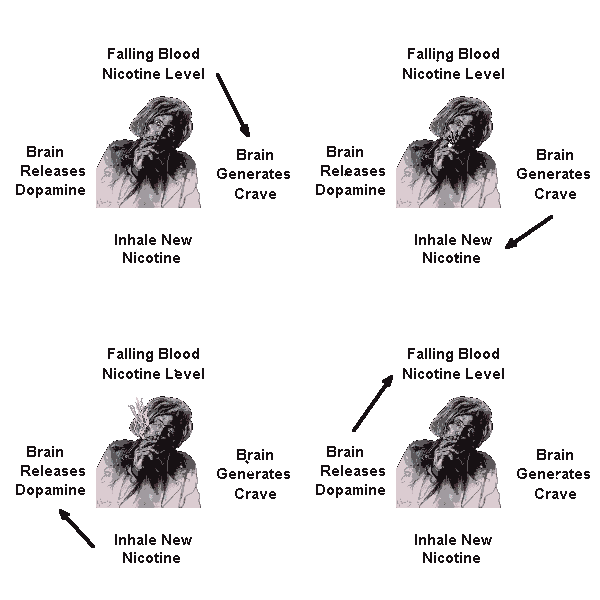
Nicotine addiction cycle

  • For most people, smoking is more than a habit. It’s a nicotine addiction. Nicotine withdrawal is why you probably feel irritable or anxious when you don’t have a cigarette.
  • When you smoke, nicotine goes to the brain in seconds.
  • When nicotine is in the brain, it causes the release of a chemical called dopamine, which gives the feeling of pleasure and calm.
  • Your body doesn’t want that feeling to stop. But when you’re between cigarettes, the level of dopamine drops.
  • Even if you want to quit, the body craves nicotine. This makes you keep smoking.
  • The more you smoke, the more nicotine you need

Over time, each cigarette you smoke may become less and less effective. That’s because, as the brain gets used to nicotine, you may need to smoke more to have the same feeling of pleasure and calm. Of course, the more you smoke, the more you inhale toxins in cigarettes that are linked to smoking-related illnesses.

How does it feel to quit?
On top of feeling the urge to smoke, you may also feel some of these common physical nicotine withdrawal symptoms.
  • Dizziness (at first)
  • Trouble sleeping
  • Tiredness
  • Trouble concentrating
  • Restlessness
  • Headache
  • Increased appetite
  • Coughing and dry throat
  • Constipation
  • Slower heart rate

These effects will lessen over time.

Next, better health
Smoking-related health risks are actually caused by the other ingredients found in your cigarettes. For example, tobacco smoke has more than 60 ingredients known to cause cancer in humans. Luckily, once you quit, your risk of getting a smoking-related illness can start to drop—almost immediately.

How your doctor can help
Quitting smoking is hard, but possible. Your doctor can talk to you about nicotine addiction and tell you about treatment options and behavior support that may be right for you.

Tips to stop smoking

Get ready to quit

Ready to start planning your quit? Here are some ways you can get ready to say good-bye to cigarettes.

  1. Make a personal commitment to yourself
  2. Are you worried about your health? Or do you want to quit for your kids or family? Think about what will make you want to give up smoking. Write those reasons down.
  3. Start building a support network to help you quit smoking
  4. Tell your friends and family that you need their support. Talk about your reasons for quitting with them, too.
  5. Make an appointment with your doctor
  6. Talk to your doctor about wanting to quit. Ask about treatment options and support. Then decide on a quit date.
  7. Set a quit date
  8. Pick a date within the next 2 weeks. That’s enough time to get ready, but not so long that you’ll lose your will to quit.
  9. Mark your calendar. You may be more likely to go through with your quit if you see your quit day in writing.
  10. Enroll in a support program to help you quit smoking
  11. Look for a program that helps with your urge to smoke and helps you break your smoking routine.
  12. Clean up your living spaces
  13. Get rid of anything that reminds you of smoking. Don’t forget to throw out lighters, ashtrays, and cigarettes the night before.
  14. Anticipate withdrawal symptoms
  15. Withdrawal symptoms are part of quitting smoking. Start to plan what you will do when you feel a symptom.
  16. Know your smoking triggers
  17. Be aware of your triggers so you can understand why you get the urge to smoke.

Things to do on the day of quit

You’ve taken steps to get ready, and now it’s time to quit. Here’s what to do on your quit day:

Make sure you’re in a smoke-free zone
Throw out your cigarettes, ashtrays and lighters at home, at work and in your car. Try to clean up and even spray air freshener.

Take advantage of professional support

  • Be sure to follow your doctor’s treatment advice.
  • Enroll in a program to help as you go about changing your smoking routine into a nonsmoking routine.

Quit, one trigger at a time
Afraid of that first cup of coffee? Don’t know what to do when you get into your car? When you’re in a situation where you usually smoke, don’t panic. Just focus on dealing with that one trigger.

You can beat your trigger

If you face a trigger, you may feel an urge to smoke. Luckily, you have some ways to help deal with cravings right at your fingertips.

  • Take a deep breath
  • Calm yourself down by inhaling and exhaling three times slowly. You can repeat this anytime and anywhere.
  • Drink plenty of water
  • Staying hydrated is healthy and gives your mouth something to do instead of smoking.
  • Call a friend
  • Instead of smoking, try talking to a friend. Probably by the time you finish chatting, your craving will be over
  • Set up a support network
  • When your quit day arrives, tell your friends and family. They can help you manage your smoking triggers
  • Exercise
  • Start a walking routine. Or join a class or a gym. Check with your doctor before starting a new activity.
  • Have a healthy snack
  • Carrots, popcorn, and even chewing gum can help you keep your mouth occupied while the craving passes.

Get the support you need
When you’re in the process of quitting, it’s not unusual to feel alone. But you’re not. In fact, there’s lots of help out there.

  • Friends and family
    Many former smokers say that the support of family and friends helped them become nonsmokers.
  • Your doctor
    Your doctor may know how hard it is to overcome nicotine addiction from smoking. He or she can talk to you about available options to help you quit smoking.
  • Professional counseling
    Counseling, one-on-one or as part of a group, can help you cope with the stress of giving up your fags.

I myself had done it. You too can. Wish you All the Best...

Now, and... Then

Nowadays, we have so many options, be it Social networking, News, Media, or whatever. And now, we feel like without these, we would be so incomplete. But do we know today that what was there in the 90s in the place of these developments! Here is a list of the top 10 things in the 90s, in which we have seen breathtaking developments:

1. Before YouTube... there was "America's Funniest Home Videos"

This 90's television smash-hit, based on a Japanese show, kicked off user-generated video content in America.

People used to submit home videos of babies with nail guns, dogs on fire, and grandmas falling down, in hopes of winning a weekly cash prize.

2. Before blogs... there were zines.

zine.jpg

If you wanted to delve in the world of personal publishing in the early 90's, it was pretty spendy. Desktop publishing with Adobe Pagemaker required investing big bucks into a high-end Mac and a state-of-the-art laser printer.

Most young people stuck to cutting and pasting scraps onto blank paper and then xeroxing the final product.

3. Before podcasts... there were codelines.

zine.jpg

In the 90's, when digital voice mail was a cutting-edge corporate technology, there was a vibrant voice mail hacking scene.

Phone phreaks from all over the United States would sequentially "scan" 1-800 exchanges for voice mail boxes (VMBs) and use default passwords to take over employees' (unused) voice mail boxes. They would record long informational greeting messages, known as "codelines." Codelines began with music and "shouts out" to other phone phreaks and then segued into first-generation "podcasts" packed with underground content: freshly hacked calling cards and credit cards, conference calls PINs, and global outdial passwords.

4. Before blogrolls and comments... there were web rings and guest books.

image credit: simon slade

webring.gif

Sites on similar subjects used link out to each other in a promotional circle jerk called a "web ring." Guestbooks used to be the hot way to leave comments, until bots were developed to harvest the e-mail addresses for the the worst kinds of spam imaginable.

5. Before Facebook... there was the 20th annual high school reunion.

image credit: Alan Light

reunion.jpg

You'd have to wait in 20 year increments – and buy a plane ticket – to catch up with many of your old friends or see their photo albums. Seriously.

6. Before Skype... there were k0dez and bridges.

k0dez.jpg

Before VoIP and cell phone plans, it was rather expensive to make a long distance call. In some cases you'd pay over a dollar a minute (!) to "reach out and touch someone." The early-adopters (a.k.a. "phone phreaks") used home computer software to hack out calling card codes ("k0dez") to keep in touch. For teleconferencing, phreaks would hack out corporate phone systems' conferencing nodes, called "bridges." Epic rap sessions and knowledge downloads would go on for weeks... until the corporate host got a massive phone bill, found out, and shut it down. Check out these awesome vintage recordings.

7. Before eBay... there was the pawn shop.

image credit:Duien

Same questionable items, high fees and unsavory characters - but in an actual, real-life retail location!

8. Before the iPhone... there was the PayPhone.

Before technology allowed people to yak loudly on cellphones in restaurants, they had to go out to the payphone.

And if they wanted to make a long distance call, they'd need an entire roll of quarters. The 90's equivalent of an "unlimited calling plan" was a toll-fraud device called a red box.  Red boxes were modified Radio Shack touch-tone dialers that made the same sound a Bell payphone made when a quarter was inserted. By the end of the decade, Radio Shack had discontinued the device and Bell had upgraded to digital equipment. Thankfully, cellphones were becoming affordable, mainstream communications devices by then.

9. Before P2P file sharing... there was Columbia House Records.

Before DRM and iTunes - people downloaded music from Napster and burned it on a $569 external CD-R drive.

Non-technical people who wanted free tracks got tempted by magazine ads that promised "Get 8 CD's for Just One Penny!" and they were unwittingly signed up for recurring CD subscriptions. Then they got slapped with a huge bill afterwards - the old-school equivalent of an RIAA settlement.

10. Before Digg... there was your local newspaper's "Top Stories of the Year" issue.

paper2.jpg

You used to have to wait until December to find out hottest story of the year. And the news stories were picked by crusty old editors. Now there's an infinite stream of high-quality, uncensored content and entertainment - all just a mouse click away.